Three ways to copy an analog box, and what each one misses.


A client sends a photo of a preamp from the seventies and asks how long it would take to turn it into a plugin. It is a completely reasonable question, and the honest answer starts with another one: which part of it do you want?
Because a box like that is really two machines wearing one chassis, and they need completely different treatment.
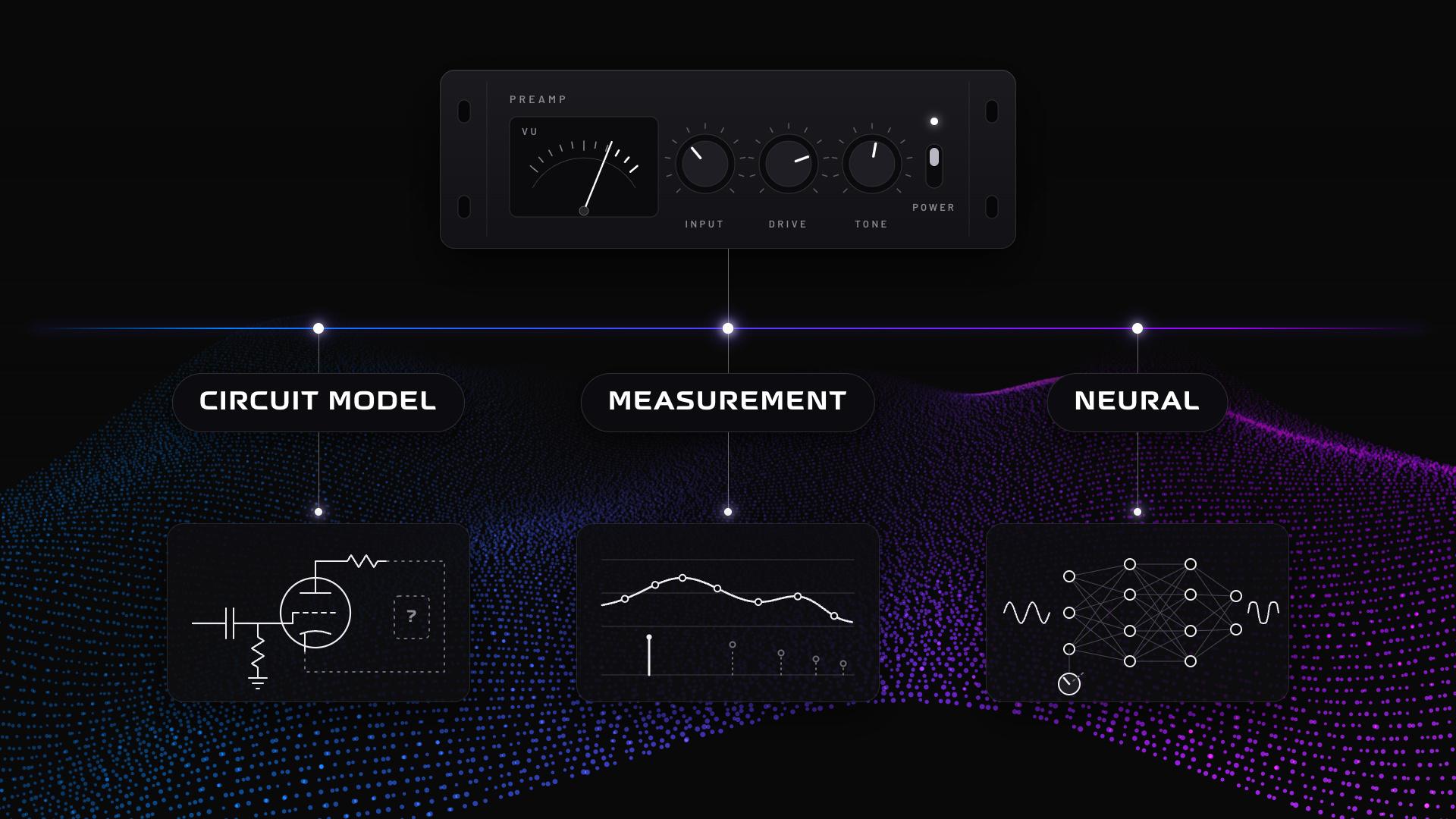
A piece of analog gear has a linear half, its frequency response, which one measurement captures exactly, and a non-linear half, the way it behaves differently when driven hard, which no single measurement can capture. Circuit modeling, black box measurement and neural networks are three ways to attack the second half.
Split the box before you copy it
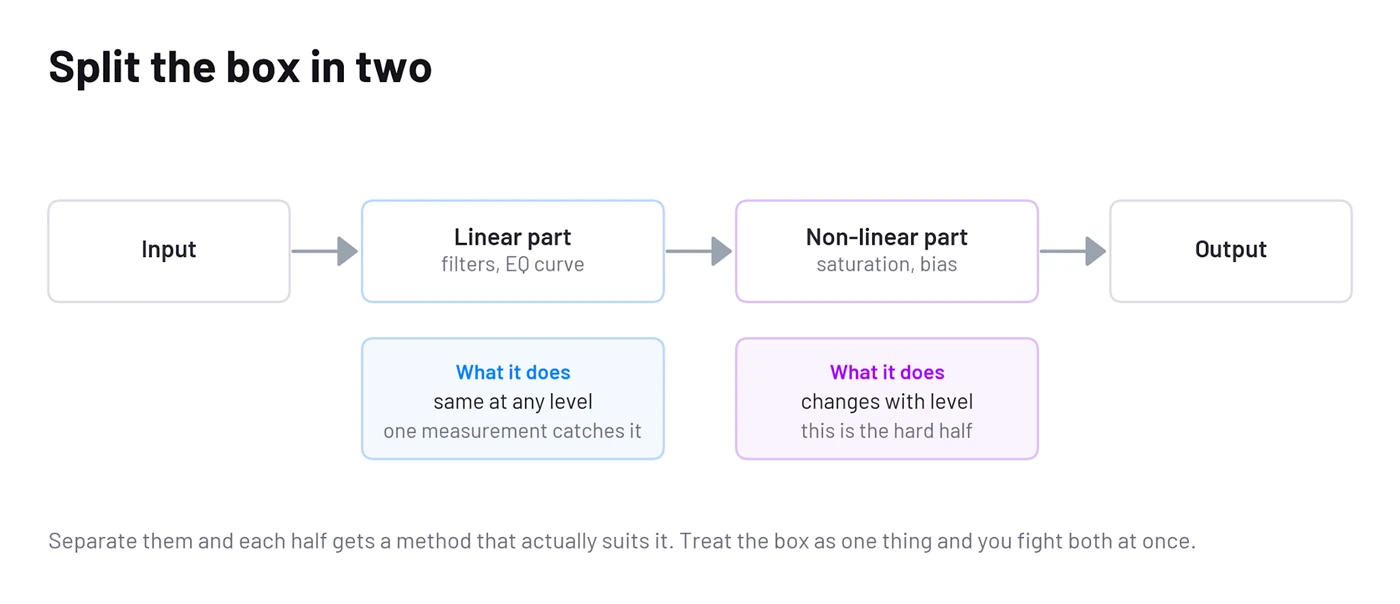
The linear part is everything that behaves the same no matter how hard you hit it. Filters, the EQ curve, the frequency response of a transformer. Double the input and you get exactly double the output, with the same shape. This half is genuinely easy, and one good measurement captures all of it.
The non-linear part is everything that changes with level. Saturation, the way a valve rounds off a loud transient, the asymmetry of a circuit that is slightly biased. This half is where the character lives, and it is the half that resists every shortcut.
Almost every argument about emulation quality is really an argument about the second half.
The three methods
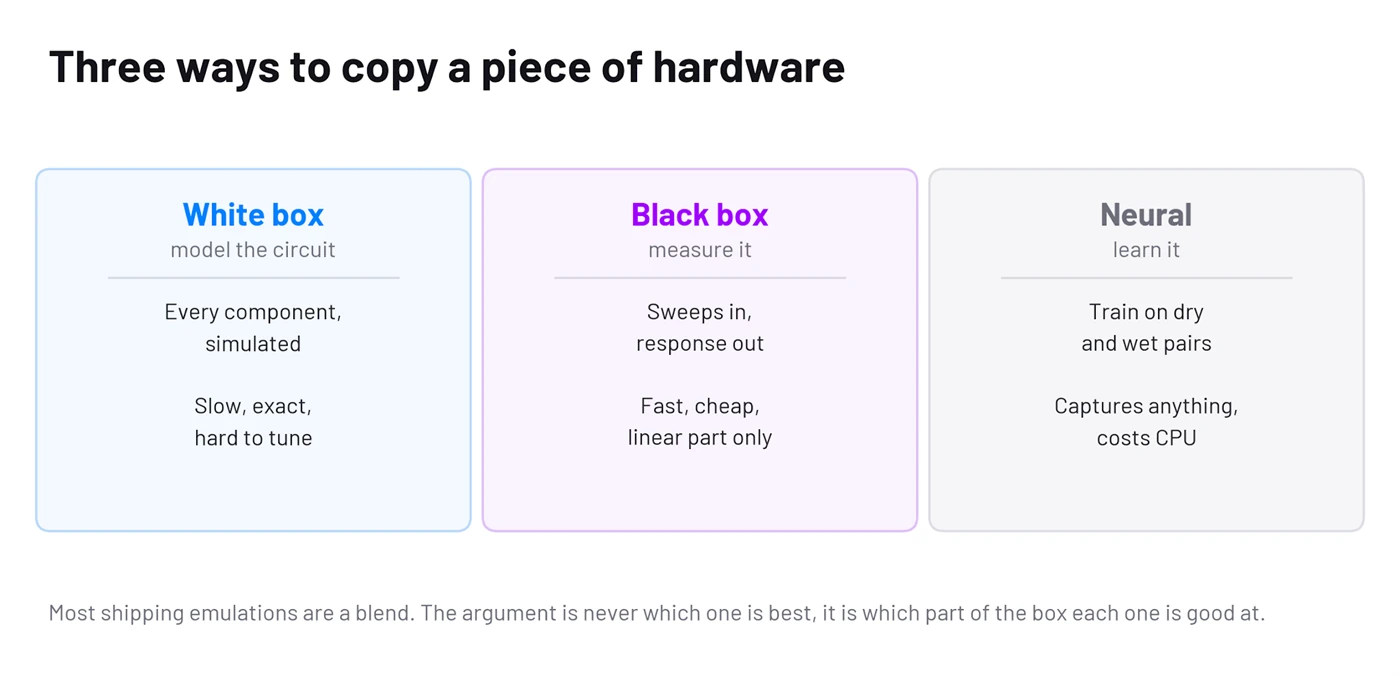
White box means modeling the circuit itself. You take the schematic and simulate the components, usually with wave digital filters or a nodal solver. Done properly it is the most faithful approach there is, because it reproduces behavior nobody thought to measure, including how the thing responds to signals you never tested.
It is also the most expensive, in two ways. It costs real CPU, because you are solving a circuit every sample and often at several times the sample rate. And it costs schematics, component values, and someone who can read them. For a rare unit whose original drawings do not exist, this route can simply be closed.
Black box means ignoring the inside completely. Put a known signal in, record what comes out, and build something that does the same thing. It is fast, it needs no schematic, and for the linear half it is close to exact.
Neural means training a network on pairs of dry and wet audio through the real unit. It captures the linear and the non-linear behavior at once, without anyone deciding in advance what matters, which is its real advantage. The costs are CPU at playback, a training set that has to cover the whole range of levels and settings, and the awkward fact that a knob is now a conditioning input the network has to have seen.
How we measure a unit
The black box route is the one we have industrialized, so here is what it actually looks like in practice.
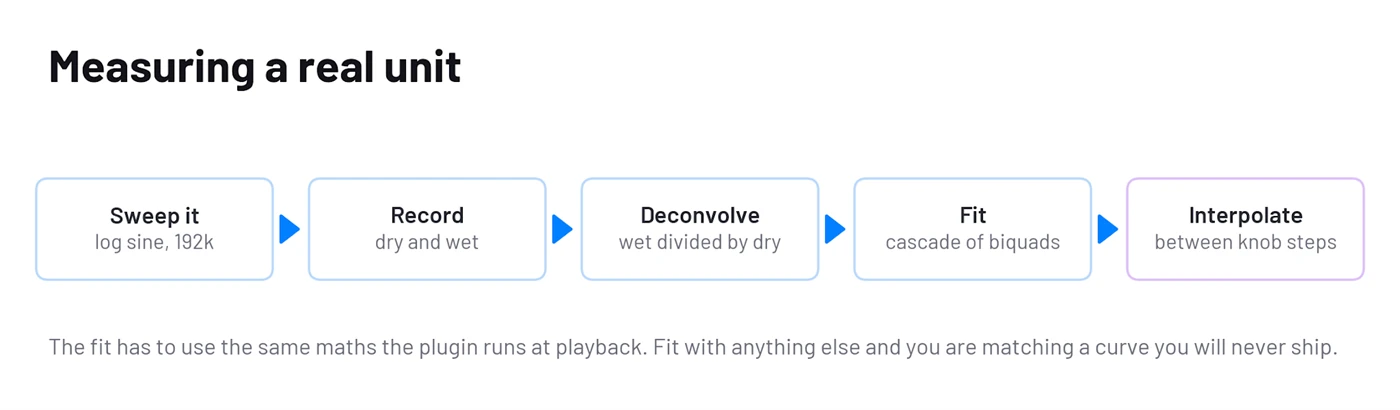
You feed the unit a logarithmic sine sweep at a high sample rate and record both the signal you sent and the signal that came back. Divide one by the other in the frequency domain, which is deconvolution, and what falls out is the measured response of the box at that setting.
Then comes the part that decides whether any of this ships. A measured response is a curve with thousands of points, and a plugin needs a handful of filter coefficients. So you fit a cascade of biquads to that curve, searching for the set of coefficients whose combined response sits closest to the measurement.
The rule we learned the expensive way is that the fit must use exactly the same math the plugin runs at playback. Not an equivalent formula, not a reference implementation from a paper, the same code path. Fit against anything else and you produce a beautiful match to a curve your product will never generate. Ours runs through a small command line tool that shares its filter code with the plugin, precisely so that cannot drift.
Finally, a knob is continuous and your measurements are not. You sweep the unit at each detented step, fit each one, and interpolate between the fitted coefficients so that turning the control in the plugin moves smoothly through the measured positions.
The half that a measurement cannot see
Now the catch that sinks naive black box work. A sine sweep measures a linear system. If the box is non-linear, the sweep measures it at one input level, and tells you nothing about what happens at another.
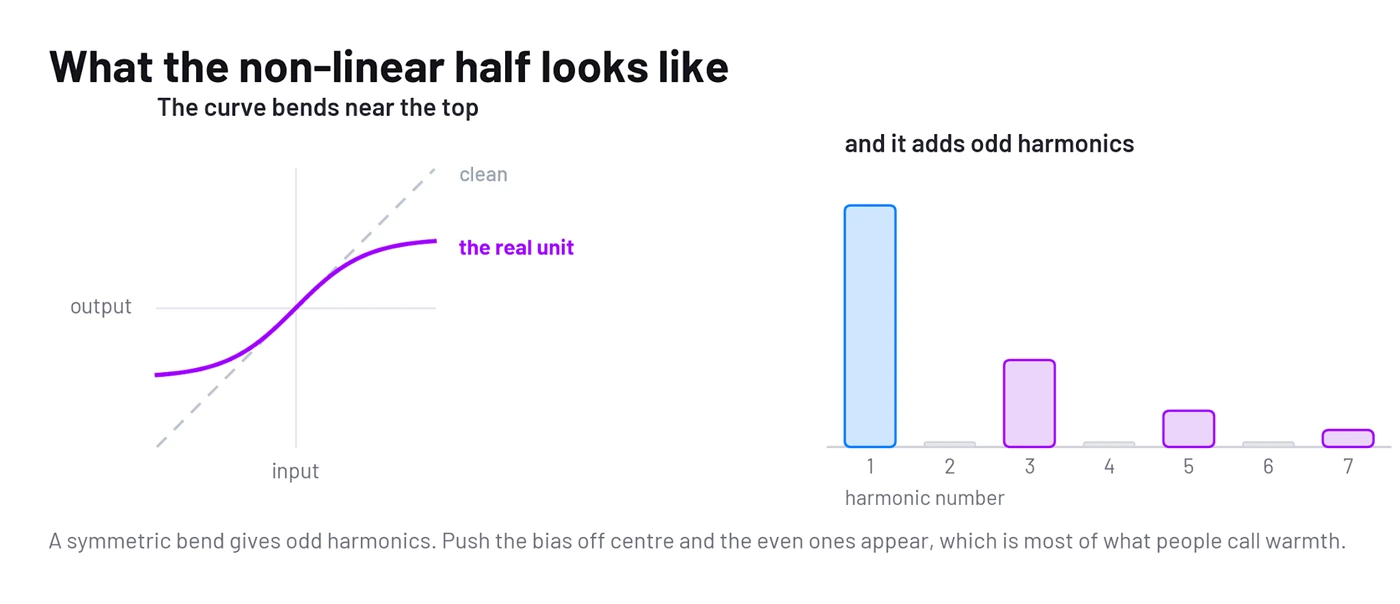
What you are looking at on the left is the shape of the non-linearity: at low levels the box does nothing much, and as you push it the output stops keeping up. That bend is what generates the harmonics on the right, frequencies that were not in the input at all. No impulse response can produce those, because an impulse response by definition cannot invent new frequencies.
So the non-linear half needs its own treatment. Measure the static transfer curve by sending steady tones at many levels and recording what comes back, then reproduce it as a waveshaper. If the harmonic content changes with frequency, and it usually does, you need filters wrapped around the shaper rather than a single curve.
And whatever you do, that curve generates harmonics above Nyquist, which fold back down as aliasing that sounds nothing like analog anything. Which is why every saturation stage in our plugins runs oversampled, typically four to sixteen times, with the shaping done up there and proper filtering on the way in and out. The oversampling is not a quality flourish. Without it the thing is simply wrong.
The descending tones in the middle clip are harmonics that went past Nyquist and folded back. They are not in the input, they are not in the hardware, and they are not musical. In the third clip they measure at essentially zero.
What actually ships
Almost nothing real is purely one method. The emulations we ship measure the linear half, because it is cheap and exact there, and hand-model the non-linear half with an oversampled shaper tuned against measurements of the real unit at many levels. Circuit modeling comes out for the parts where the interaction genuinely matters and we have the schematic. Neural is the strongest option when the behavior is too tangled to describe and the CPU budget can absorb it.
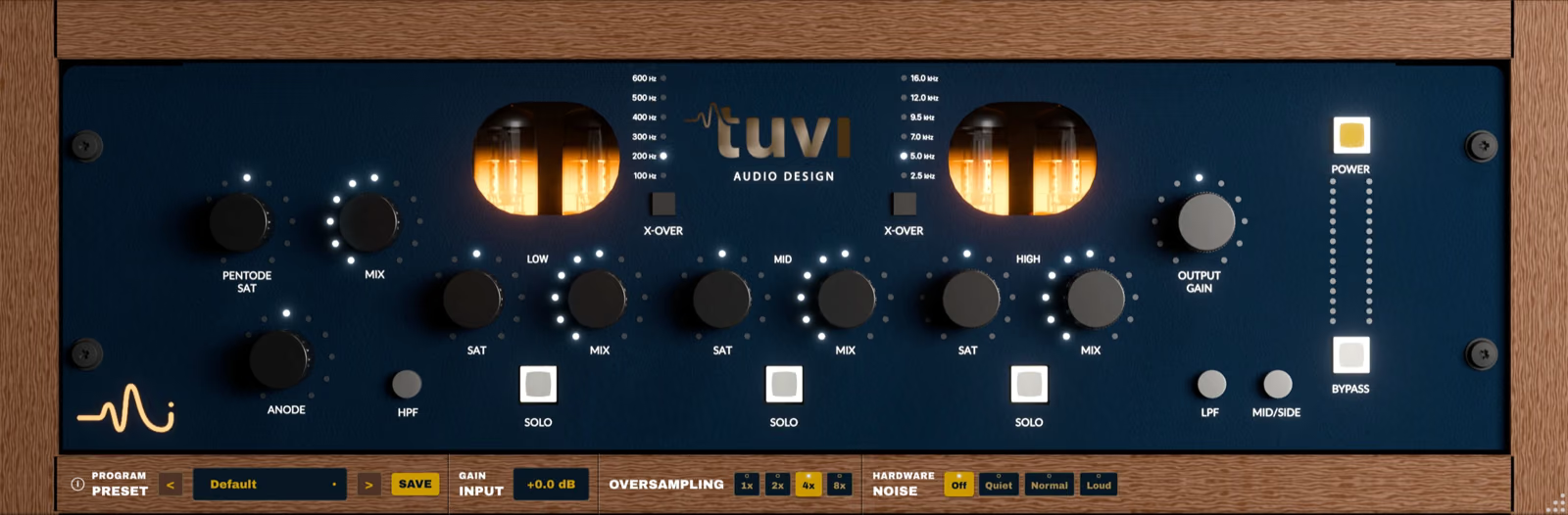
That's how we built the Multiband Harmonic Enhancer for Tuvi Audio, where we emulated the valves of their hand-built unit (a pentode at the input and a triode in each of its three bands) from measurements of the real hardware.
The same window and overlap questions that govern a measurement rig show up again in time stretching and pitch shifting, for exactly the same reasons.
The useful question is never which technique is best. It is which part of the box each technique is good at, and what the product can afford.
We build these at Edge Audio Labs, including the measurement rig, the fitting tools and the plugins that come out the other end. If you have a box on a shelf and a suspicion that it should be software, we have done this walk a few times.
Joaquin SaavedraCEO & Co-Founder
Co-founded Edge Audio Labs and has spent the last decade building audio software (plugins, DSP and AI pipelines) for companies that ship it to musicians.
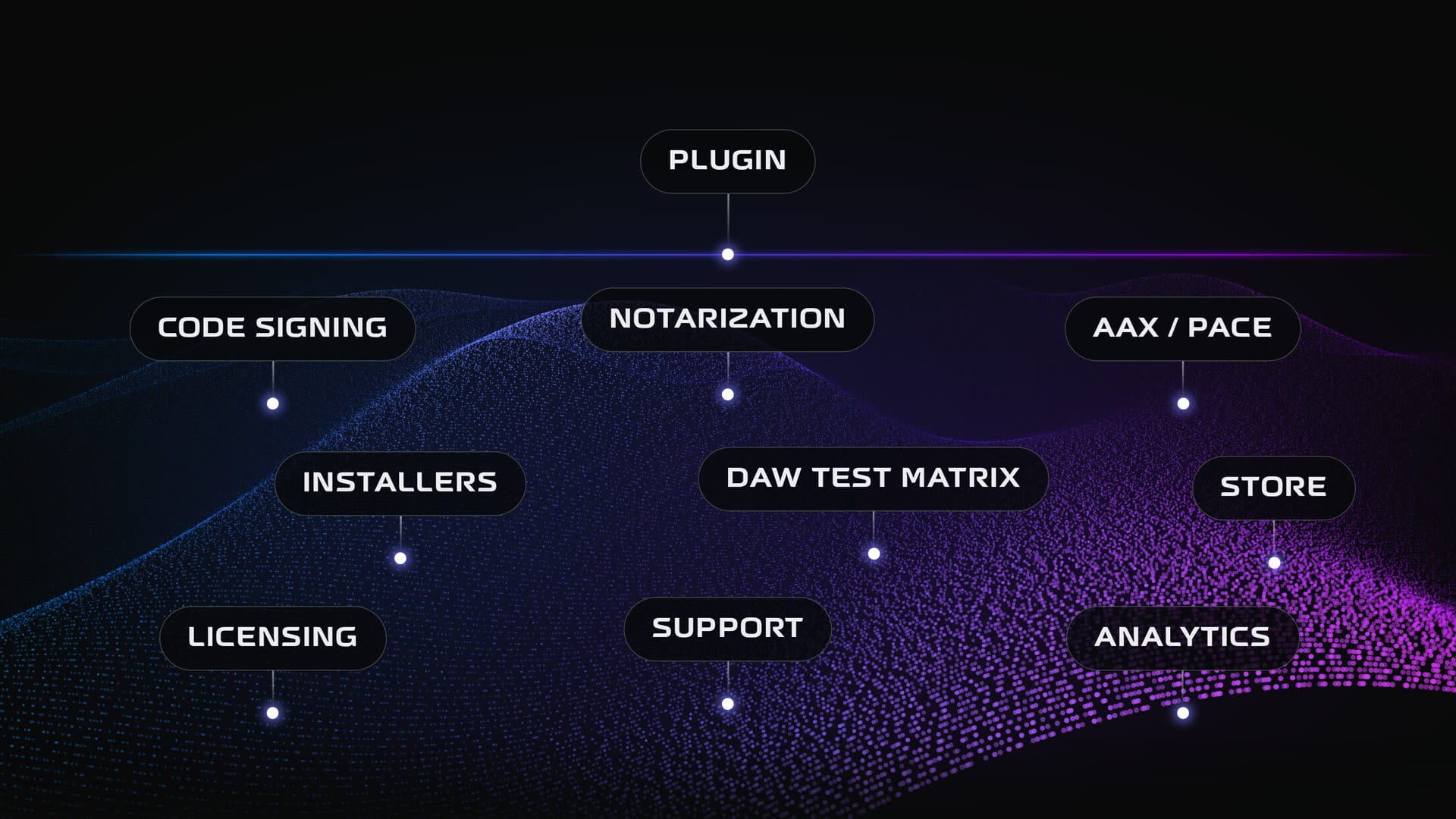
What it actually takes to ship an audio plugin
Code signing, notarization, AAX and PACE, the DAW test matrix, licensing, support and analytics: everything between a finished plugin and a paying customer.

8
min read
Read more